
Customer reviews are more than just stars: they are your underestimated growth driver. Learn how to use qualitative feedback as a strategic data source to validate product data, reduce returns, and ensure SEO success. Transform your data quality!
Forget for a moment your painstakingly optimized marketing campaigns and glossy product photos. In the reality of modern e-commerce, the actual purchase decision often takes place in an area that many brands criminally neglect: the comments section at the bottom of the product detail page. Here, the balance of power has shifted radically. While companies invest millions in advertising promises, the unfiltered voice of “peers,” i.e., other buyers, determines the success or failure of a product.
Customer reviews are no longer just a nice “social proof” widget that you include for the sake of it. They are an objective authority and, more importantly, they are a gigantic, unstructured treasure trove of data. But while the marketing department often sees reviews purely as a lever for conversion rates, product management often overlooks their greatest potential: reviews as a highly qualitative data source for optimizing your entire product range. In this article, we analyze why “star hunting” falls short, how customer reviews can become a reality check for your product data, and how you can make this feedback loop technically scalable.
Before we talk about data structures, we need to understand the psychology behind reviews. Online reviews, technically classified as user-generated content (UGC), minimize the risk of purchasing. They offer guidance in an anonymous environment and simulate personal recommendations from friends and acquaintances. In a world full of interchangeable offers, customers are looking for precisely this bridge between an anonymous product and their personal purchasing decision.
Today, a product without reviews often seems incomplete or even suspicious. It's not just about the best rating. Customers are looking for authenticity, not perfection. They want to know whether the product works in their real life.
Interestingly, the pursuit of a flawless 5.0-star rating often leads astray. Modern consumers are “review-smart.” A flawless score across hundreds of reviews seems unnatural or even manipulated to many buyers today. Products with an average rating between 4.2 and 4.7 stars often convert better than those with a perfect 5 stars.
Why is that? Because customers are looking for the “catch.” They specifically read the critical voices to assess the worst-case scenario for themselves. Can I live with a slightly louder operating noise? Does the slightly different color temperature really bother me if the design is right? This transparency creates a level of trust that no marketing text can ever achieve.
For you as a company, this means that every review, whether positive or negative, is a valid data point that closes the gap between your promise and your customers' reality. If you learn to see these criticisms not as flaws, but as aids to optimization, you can turn dissatisfied customers into a valuable resource for your product development.
In e-commerce, we distinguish between two basic levels of feedback that serve different purposes:
Star ratings are easy to consume. They are used for filtering and quick comparison. They are a decisive ranking signal for algorithms on marketplaces such as Amazon or in Google search results. However, they do not provide an answer to the “why.”
This is where the real strategic treasure lies. In the written word, customers leave the world of ratings behind and describe their real product experience. They use language that often differs greatly from the internal “corporate language” of marketing. These texts contain valuable information about fit, feel, or unforeseen contexts of use.
Companies often create data sheets based on technical standards. Customers, on the other hand, evaluate products based on whether they meet their expectations and are suitable for everyday use. When a customer writes a review, they usually focus on the following criteria:
These criteria are practical and subjective, but together they form an objective picture of product quality that no lab report can replace.
A picture says more than a thousand data sheets. One major trend you need to keep an eye on is the growing importance of visual customer reviews. When buyers upload their own photos or short videos of themselves unboxing your product or using it in everyday life, this is the most honest form of product presentation for potential new customers.
Why is this so important for you strategically? Because professional studio shots often look “too perfect.” Customer photos, on the other hand, show reality: What does the texture of the fabric look like in indirect daylight? How big does the food processor look on a normal countertop?
This visual content provides you with direct insights for your central image management. If customer images show details that are missing from your official product photos, that's a clear signal. Perhaps the back of a device is more important for the purchase decision than you thought, or a certain color is often perceived incorrectly under artificial light. By using this visual feedback loop, you not only optimize your visual language, but also actively reduce the return rate because visual expectations are more accurately matched to reality.
Any negative review based on a lack of information is an indication of a data gap. If customers repeatedly complain about the color (“looks bluer in the photos than in real life”), there may be an error in the digital asset management (DAM) system, such as Tessa DAM. If questions arise about cable length, this attribute is missing from the technical specifications.
Customer reviews thus serve as an unstructured data source. They contain emotions and individual expressions that are more difficult to manage than an Excel spreadsheet, but that is precisely why they bridge the gap between technical specifications and emotional purchasing decisions.
Once the product range reaches a certain size, it is no longer possible to process this information manually. A systematic approach is needed to make the “reality check” provided by customer feedback scalable. This is where the model shifts from a static data flow to a learning ecosystem.
In order for an “opinion” to become a reliable data point, reviews must be structured. The modern workflow looks like this:
1. Aggregation: Collecting feedback via portals or your own shop.
2. AI analysis: Use of natural language processing (NLP) to identify recurring pain points and missing attributes.
3. Validation: Comparison of customer insights with existing master data.
4. Improved PXM (product experience management): Feedback ensures that the “voice of the customer” directly influences the way products are presented.
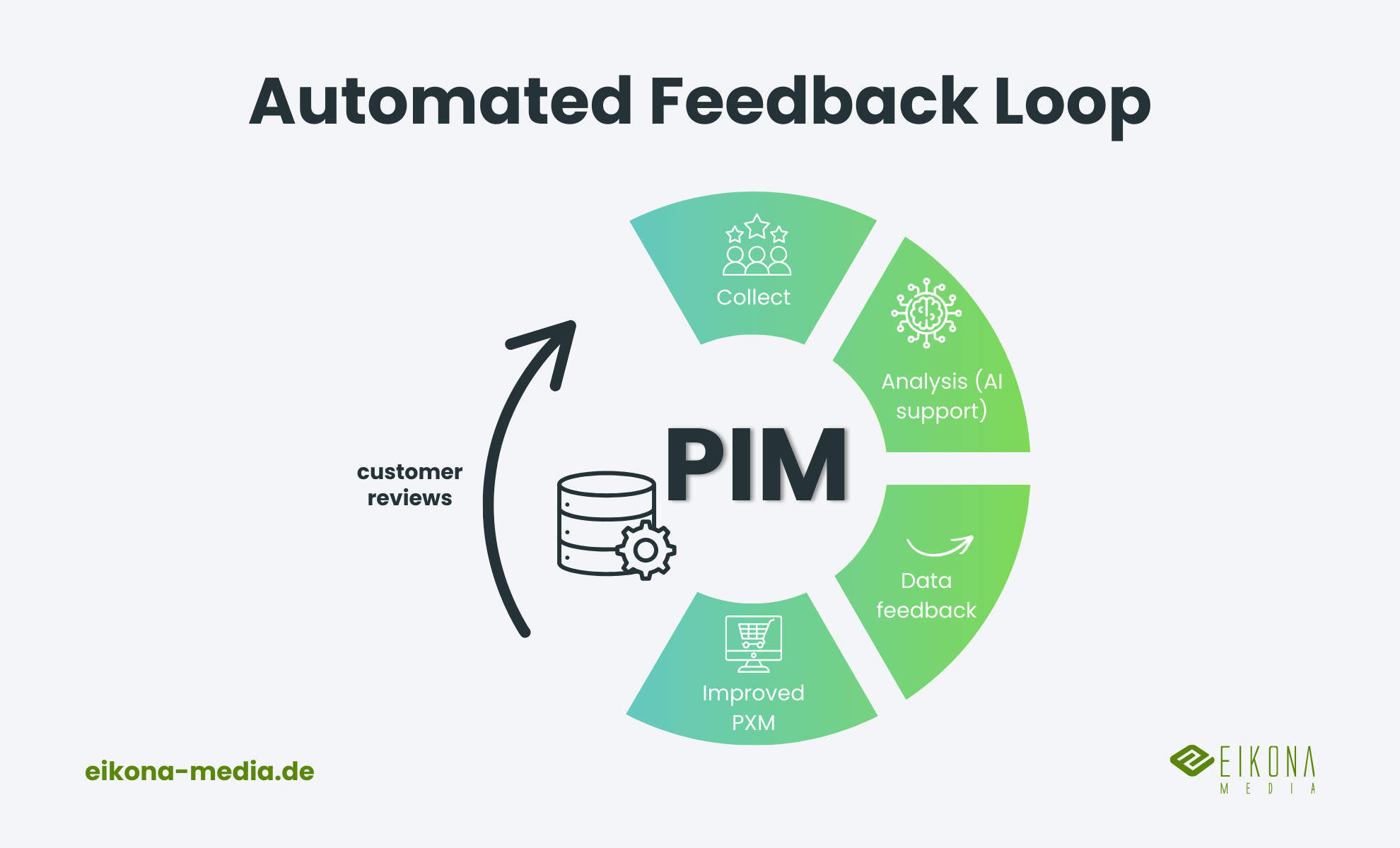
This is where product information management (PIM) becomes indispensable. But let's do a reality check: Although a PIM system acts as a “single source of truth,” from a technological standpoint, it is initially an isolated vault without native data feedback from outside sources. If you want bilateral communication, you have to actively build it, because two-way data exchange is not a standard feature, but a strategic upgrade via API and extensions.
In the Akeneo world (especially with Akeneo Serenity), “PX Insights” is the game changer here. Only through such interfaces can the necessary bridges to channels such as Google Shopping or your own shop be created in order to feed valuable insights back into the system.
Important to note: we are not talking about the “Wild West” of automation here. No smart company lets AI create attributes or options in the database unchecked. Instead, AI-supported workflows are used. Modern AI functions scan customer reviews and serve the marketing team structured recommendations for action on a silver platter. Thanks to this “human-in-the-loop” principle, humans retain data sovereignty and decide what really goes into the system:
Search engines love fresh, relevant content. Since customers often search in the language they use to write reviews, reviews provide valuable long-tail keywords in a completely organic way. If these insights are used to refine product texts in the PIM, visibility for specific search queries increases significantly.
Despite the potential, strategic use often fails to materialize. The biggest risks:
Customer reviews are much more than a psychological tool for promoting sales. They are a strategic resource for data quality. Those who learn not only to listen to the “voice of the customer” but also to integrate it into their data processes in a structured way will transform their marketing from a purely one-way street into a learning cycle.
Systems such as Akeneo or specialized solutions such as TESSA provide the necessary infrastructure to technically map this feedback loop. Ultimately, better product data leads to clearer expectations, fewer returns, and sustainable economic success. Integrating customer insights into the central PIM system is therefore the next logical step in the digital maturity of an e-commerce company.