
Clean interfaces are the backbone of successful e-commerce projects. Only when shops, ERP, PIM, marketplaces, and analytics interact seamlessly can data remain consistent and processes efficient. In this article, we show why interfaces are a key success factor in e-commerce, which systems are typically connected, where common problems arise, and how clean interfaces become a competitive advantage.
In e-commerce, it is no longer just the front end that determines success or failure. A high-performance shop, fast loading times, and good design are important, but in the background, interfaces play an equally important role in e-commerce. They connect shops, ERP, PIM, marketplaces, payment providers, and shipping service providers with each other. If these interfaces are implemented cleanly, data flows smoothly, automatically, and without errors. If they are not, data chaos quickly ensues, slowing growth and tying up resources.
Interfaces in e-commerce are technical connections between different systems that enable the automated exchange of data. These are usually APIs (application programming interfaces), middleware solutions, or standardized import and export processes. This automatically connects relevant services with each other.
Typical data transferred via interfaces includes:
A rough distinction is made between frontend interfaces (e.g., to payment or tracking services) and backend interfaces, which control the actual business processes. The latter are particularly critical in e-commerce, as they determine efficiency, scalability, and data quality.
In practice, e-commerce relies on several different technologies, which differ in structure, speed, and purpose. Which one makes sense depends on the systems involved and the requirements for data freshness and volume.
REST APIs are the standard for most modern integrations today. They typically use the JSON data format, are relatively lightweight, and are faster to implement and maintain than older technologies.
SOAP is older and more strictly standardized than REST. It is still commonly found in established ERP and inventory management systems that have been in use for a long time.
EDI (Electronic Data Interchange) remains widespread in B2B and wholesale environments, for example for the standardized exchange of orders, delivery notes, and invoices between trading partners.
GraphQL is increasingly used when a frontend needs to query only the specific data it actually requires. This is particularly relevant for headless commerce setups, where several frontends access the same backend data.
Webhooks complement classic APIs by notifying systems about events in real time, for example when an order comes in or a stock level changes. Instead of a system constantly polling for updates, it gets notified automatically.
In e-commerce, data is the backbone of all processes. Every order, every price change, and every stock movement is based on data that is exchanged between systems. If this data is inconsistent, delayed, or incorrect, it has a direct impact on operational business.
Clean interfaces in e-commerce ensure that:
Conversely, poorly implemented interfaces often lead to manual workarounds, duplicate data maintenance, and unnecessary sources of error. These problems become even more acute as business volumes grow.
An often underestimated aspect of interfaces in e-commerce is the clear separation between master data and hot data.
Master data is relatively stable information such as
It rarely changes and can be synchronized with a time delay.
Hot data, on the other hand, includes highly dynamic data such as
This data must be available in near real time, as it has a direct impact on purchasing decisions and operational processes. If master data and hot data are processed using the same mechanisms or cycles, this quickly leads to performance problems or inconsistent information. Clean interfaces deliberately take these differences into account – with different synchronization logics, priorities, and technical solutions for stable processes and an optimal customer experience.
As soon as more than two systems need to be connected, the question of the right integration architecture arises. There are generally three common approaches.
With a point-to-point connection, every system is connected directly to every other system. That works fine with two or three systems, but it gets noticeably more complex with each additional one. Every connection has to be developed, tested, and maintained individually, which drives up the cost of maintenance and further development over time.
iPaaS solutions (Integration Platform as a Service) offer ready-made, cloud-based connectors for common systems. This works well for standard scenarios but quickly reaches its limits once individual business logic, special data structures, or edge cases need to be handled.
Middleware is built to solve exactly this problem: it acts as a central layer between the individual systems, translates data formats, orchestrates data flows, and decouples the systems from one another. A new system can be connected to the middleware without touching any of the existing connections. This is exactly the principle behind OSKAR, the middleware developed by EIKONA Media: instead of wiring every system together individually, data exchange runs through this one central layer, which makes interface projects more predictable and easier to extend than pure point-to-point setups.
Which approach fits best depends on the number of systems involved, how quickly the system landscape is expected to change, and individual requirements. Businesses that expect to grow or regularly connect new channels and systems are generally better positioned with a middleware.
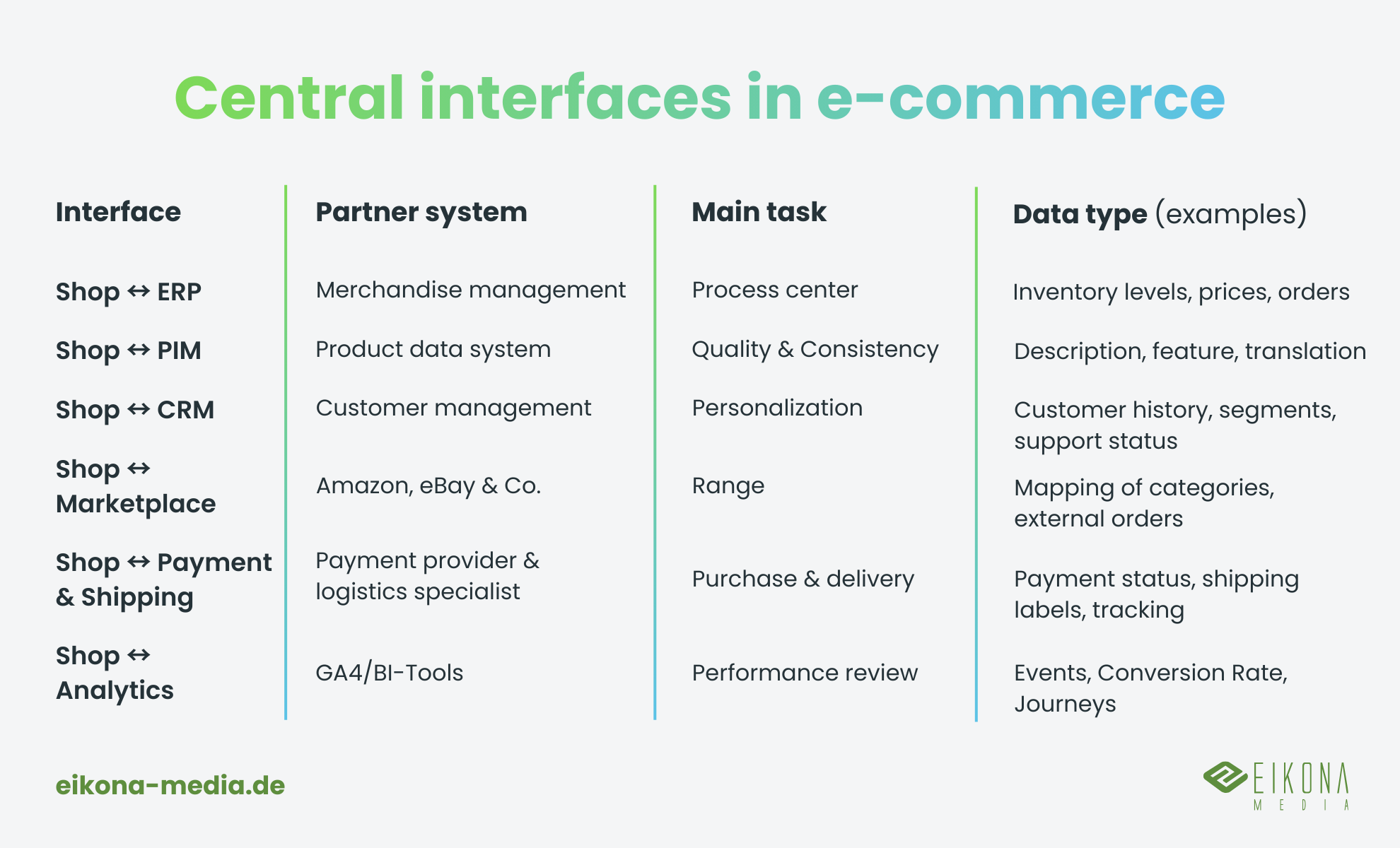
Modern e-commerce landscapes consist of a multitude of specialized systems. Here is an overview of the most important interfaces:
The interface between the shop system and the ERP is usually the most critical connection in e-commerce. This is where orders, customers, invoices, credit notes, and inventory levels are synchronized.
A clean shop-ERP interface ensures that:
Orders are automatically transferred to the ERP.
Inventory levels are updated in real-time or near real-time.
Invoices and delivery notes are generated correctly.
Problems in this area quickly lead to overselling, incorrect deliveries, or shipping delays.
A Product Information Management (PIM) system serves as the central source for product data, while a Digital Asset Management (DAM) system handles visual elements and files. Both must work together seamlessly—for example, Akeneo combined with TESSA DAM. The interface to the shop transfers:
Product descriptions
Images and media
Attributes and variants
Translations
A PIM (combined with a DAM) is virtually indispensable, especially for large assortments or multichannel setups. A clean interface ensures that product data is displayed consistently across all channels.
While the ERP maps logistical processes, the CRM focuses on the customer. The interface between the shop and the CRM ensures that anonymous buyers become loyal, repeat customers. This interface synchronizes:
Customer history: Who bought what and when?
Preferences & Interests: Does the customer click on discounts or new collections?
Support tickets: Are there open complaints or inquiries?
Segmentation: Target groups for personalized email marketing (e.g., newsletter integration).
A clean CRM connection enables a 360-degree view of the customer. This forms the basis for personalization and targeted after-sales marketing, which significantly increases the repurchase rate.
Marketplaces such as Amazon, eBay, or OTTO are key revenue drivers for many retailers. The connection is usually established via specialized interfaces or middleware solutions.
Typical challenges include:
Differing data models
Complex mapping of categories and attributes
Adjustments for images and files
Synchronization of prices and stock levels
Processing of orders and status updates
Without stable interfaces, marketplace selling quickly becomes cluttered and prone to errors.
Payment providers and shipping services are also connected via interfaces. They provide information regarding:
Payment status
Transaction details
Shipping labels
Tracking numbers
A reliable connection is essential for smooth checkout processes and transparent customer communication.
In addition to product, order, and customer data, digital analytics data plays a central role in e-commerce. It provides insights into user behavior, conversion rates, bounce rates, campaign performance, and customer journeys.
This data is generated in tools such as Google Analytics (GA4), Matomo, or specialized BI solutions, and it reaches its full value only when linked to operational systems via interfaces. For example, analytics data can be combined with product data from the PIM, revenue from the ERP, or campaign information from marketing systems.
Properly implemented interfaces ensure that tracking data is consistent, privacy-compliant, and usable across systems. The result is a solid foundation for decision-making, more precise optimization, and a tight integration of marketing, technology, and business operations.
In practice, we repeatedly see similar problems when interfaces have not been properly planned or implemented:
Often, these problems are not immediately apparent, but develop gradually—until they have a massive impact on day-to-day business.
There is no flat-rate price for interface projects, the starting points simply differ too much from one another. In practice, the actual cost and timeline mainly depend on the following factors:
As a result, project timelines range from a few days for established standard connectors between well-known systems to several months for complex custom projects involving multiple systems and special requirements. Businesses that choose a middleware over individual point-to-point solutions from the outset reduce the effort required for every future connection: new systems are connected to one central layer instead of building each connection from scratch. This makes the cost of future expansion far more predictable.
Clean interfaces don't happen by chance. They are the result of well-thought-out architecture and clear processes.
One of the most important questions is: Which system is the “single source of truth”? Which is the leading system for which type of data? Product data usually belongs in the PIM, orders in the ERP, and customer master data in a central CRM system. Conflicts can only be avoided if it is clearly defined where data is maintained and who is responsible for it.
Modern interfaces are based on standardized technologies such as REST APIs, webhooks, and structured data formats such as JSON. The implementation of these standards is essential. They offer sufficient flexibility, improved maintainability, and greater future-proofing compared to individual special solutions.
What works today with 50 orders per day must also run stably tomorrow with 5,000 orders. Interfaces should be designed in such a way that they can easily handle peak loads, internationalization, and additional sales channels.
Clean interfaces require transparency. Logging, i.e., monitoring with clear error messages, helps to identify problems early on and fix them in a targeted manner. And that's before they affect customers or sales.
When implemented correctly, interfaces in e-commerce are not just a technical detail, but a real competitive advantage. They enable:
Companies with stable interfaces can react faster, work more efficiently, and grow more sustainably.
Interface projects are complex. They involve not only technology, but also processes, organization, and business models. An experienced e-commerce agency takes on several roles in this process:
The goal is not only to connect systems with each other, but also to create a stable, scalable e-commerce architecture that works in the long term.
Interfaces in e-commerce are not just “nice to have.” They are a key success factor for efficient processes, satisfied customers, and sustainable growth. Clean interfaces ensure clean data, and clean data is the foundation of any successful e-commerce strategy.
Investing in a well-designed interface architecture early on saves time, money, and stress later on. At the same time, it creates the basis for responding flexibly to new requirements and market opportunities.